
Sexual Abuse and Incest
Realities and Protection Mechanisms
Incest and sexual violence—whether perpetrated within or outside the family—constitute a serious, systemic, and destructive violation of fundamental rights. Recognized under international and criminal law as extremely serious crimes, they shatter the physical and psychological integrity of victims, whether they are minors, vulnerable individuals, or people with disabilities.
The particular vulnerability of people with disabilities
Children with disabilities bear a disproportionate burden of this violence: up to 68% of girls and 30% of boys with an intellectual disability or a developmental disorder will experience sexual abuse before reaching the age of majority (proposed European regulation). Among women with autism, a French study (CNRS, Association francophone de femmes autistes) reveals that nine out of ten have already experienced sexual assault, an attempted rape, or rape at some point in their lives.
This heightened vulnerability stems from increased dependence on caregivers for personal care, social isolation, communication barriers, and the fear that their accounts will be dismissed.
What Is Incest? Definition and Legal Framework
Incest represents a complete violation of the family’s protective function: it encompasses assaults, rapes, or sexual touching committed by a parent, an ascendant, a collateral relative, or any person exercising legal or de facto authority, by taking advantage of a breach of trust.
Long absent from the Penal Code as such, the concept of incest was introduced with the law of March 14, 2016: Since this reform, rape or sexual assault committed against a minor is classified as incestuous if the perpetrator is an ascendant, a brother, a sister, an uncle, an aunt, a nephew, a niece, or the spouse of one of these individuals, provided that the perpetrator exercises legal or de facto authority over the minor.
However, this progress remains limited: cousins are not covered, as there is no legal prohibition against marriage between them, and the law has not created a separate offense—it merely adds an aggravating circumstance to rape and sexual assault, with the issue of the victim’s consent still requiring determination, regardless of the victim’s age.
The Mechanics of Control
Attacks rarely rely on brute force, but rather on a methodical process:
- Targeting emotional, material, or physical dependence.
- The gradual erosion of boundaries under the guise of “play,” “affection,” or care.
- Silencing people through fear, shame, and emotional blackmail (“If you speak up, the family will fall apart”).
An alarming scale
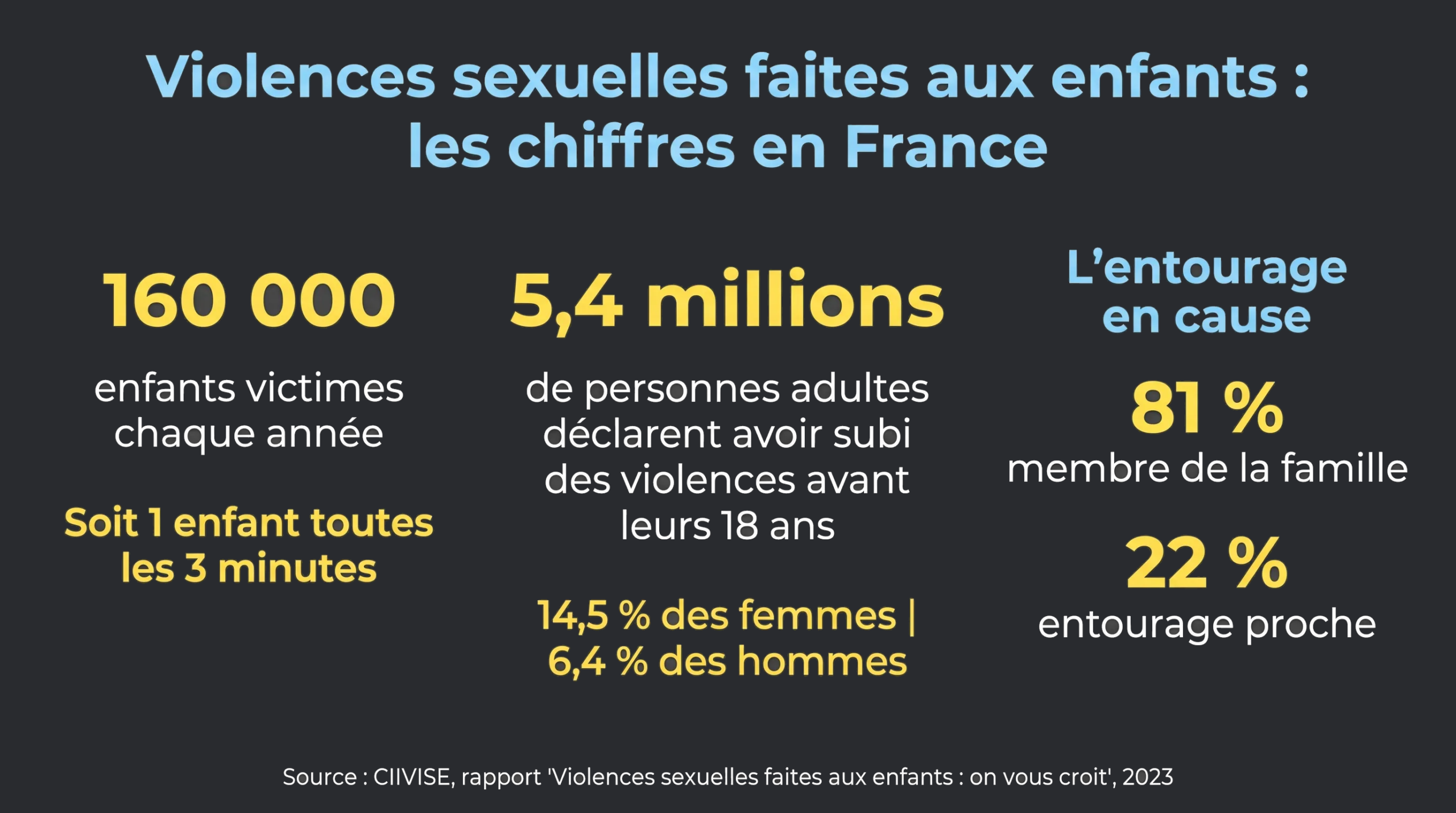
In Europe, the Council of Europe estimates that approximately one in five children experiences some form of sexual violence during childhood. Worldwide, UNICEF (October 2024) estimates that 370 million girls and women alive today—or one in eight—have experienced rape or sexual assault before the age of 18; this figure rises to 650 million—or one in five—when non-physical forms of violence (verbal or online abuse) are included.
Long-term traumatic consequences
The repercussions are profound and long-lasting: severe psychological disorders (post-traumatic stress, depression, addictive behaviors), physical symptoms, impaired self-esteem, and lasting difficulties in forming trusting relationships.
In the face of this violence, recovery is possible: professionals and support services are available, and no victim should have to face this alone. Find contact information and resources on our “Report and Get Help” page.