
Understanding the Urgency
Understanding the Urgency
Child Sexual Exploitation: Realities, Mechanisms, and Protection Issues
Online child sexual exploitation refers to all acts of sexual exploitation committed against minors via the Internet and digital technologies: the production, distribution, and viewing of child pornography; grooming (approaching minors for sexual purposes); coercion; and manipulation. This phenomenon is exacerbated by anonymity, the ease of distribution, and the global reach of digital tools.
Beyond its online manifestations, the sexual exploitation of minors constitutes, more broadly, a serious and systematic violation of the fundamental rights of children and adolescents. Recognized under international law as a form of institutional, social, and criminal violence, it occurs both in the physical world and in the digital ecosystem.
Distinguish Between Key Concepts
- Child sexual abuse: all criminal acts committed against minors (sexual exploitation, production and distribution of child pornography, harassment, psychological manipulation).
- Cyberchild sexual abuse: these same acts facilitated or committed via the Internet (grooming, sexual exhibitionism, non-consensual sharing of content, remote exploitation).
- Sexual exploitation of children: any act or behavior intended to sexually exploit a minor, either directly in the physical world or through digital media and platforms.
Legal, preventive, and technological measures designed to counter these threats are now essential for protecting children, ensuring their safety, and holding the perpetrators of these crimes accountable.
The Broader Target Audience: From Childhood to Adolescence
Contrary to popular belief, this violence does not affect only young children: criminal networks actively target adolescents, exploiting their need for independence, their search for identity, and their online social interactions. Adolescence is a pivotal period during which the risks of grooming and sextortion are particularly high.
The Multiple Dimensions of Sexual Exploitation
The sexual exploitation of minors most often occurs along a continuum of predation and domination:
- Commercial exploitation and trafficking: the use of minors for prostitution, pornography, or paid sexual services, often orchestrated by organized criminal networks.
- Production and distribution of child sexual abuse material (CSAM): recording, storing, and sharing depictions of minors being abused, which constitutes ongoing victimization every time the material is viewed.
- Forms facilitated by digital technology: sextortion, livestreaming of abuse, and grooming—all via platforms, encrypted messaging apps, and virtual currencies.
The Mechanics of Control: Understanding the Exploitation Process
Sexual exploitation rarely relies on initial brute force, but rather on a process of methodical manipulation:
- Identifying and targeting vulnerabilities: The abuser exploits the minor’s vulnerabilities (isolation, need for affection, low self-esteem, disability).
- Establishing an exclusive bond: The abuser falsely becomes involved in the young person’s life in order to become their sole point of reference, isolating them from their support networks (family, friends, school).
- A Shift Toward Coercion: Once control is established, the abuser creates a relationship of domination based on blackmail, threats, guilt-tripping, and fear, thereby crushing any resistance or attempts to speak out.
The Digital Ecosystem
Social media, sharing platforms, instant messaging apps, and online games (through their built-in chat features) have become prime targets, characterized by their immediacy and transnational nature. The recruitment tactics center on isolation, building false relationships of trust, psychological coercion, and blackmail using images.
The Dark Web: The Gray Area of Criminal Anonymity
Beyond the visible web, the Dark Web is a digital space inaccessible to conventional search engines, where communications are heavily encrypted and anonymity is absolute. This underground ecosystem is extensively exploited by international child sex trafficking networks to:
- To hide and share child sexual abuse material, out of reach of traditional moderators.
- Selling illicit services and monetizing access to live abuse streams using cryptocurrencies, whose decentralized nature makes it difficult for investigators to trace financial flows.
Combating these virtual safe havens requires highly specialized international law enforcement cooperation and cutting-edge cyber-surveillance technologies.
The Impact of Artificial Intelligence on Cybercrime
Generative AI introduces unprecedented complexity: the creation of deepfakes, the manipulation of legitimate photographs for the purpose of sexualization, and new forms of revictimization and blackmail. European and international legislation now addresses these offenses, imposing greater accountability on digital service providers.
Legal Liability and the Regulatory Framework
The Digital Services Act (DSA), which took full effect in February 2024, imposes strict regulations on digital platforms and ISPs:
- Safety by Design: Designing platforms from the outset with mechanisms to detect risky behavior and human oversight of moderation.
- Obligation to Remove Illegal Content: Once notified (by a public authority or through a user report), a platform has a legal obligation to act immediately to remove illegal content. This framework is based on a principle derived from European law: a platform is not automatically liable for content posted by its users, but it becomes liable as soon as it is notified and fails to act; it is precisely this mechanism that underscores the importance of reports from the public.
- An End to the Commercialization of Abuse: Since 2024, European law has prohibited the targeting of minors with personalized advertising.
In France, the law of July 7, 2023, established the digital age of majority at 15. The regulations were tightened on July 21, 2026: access to social media will remain prohibited for children under 15 without parental consent, with the rule taking effect gradually starting September 1, 2026, for new registrations, and then January 1, 2027, for existing accounts.
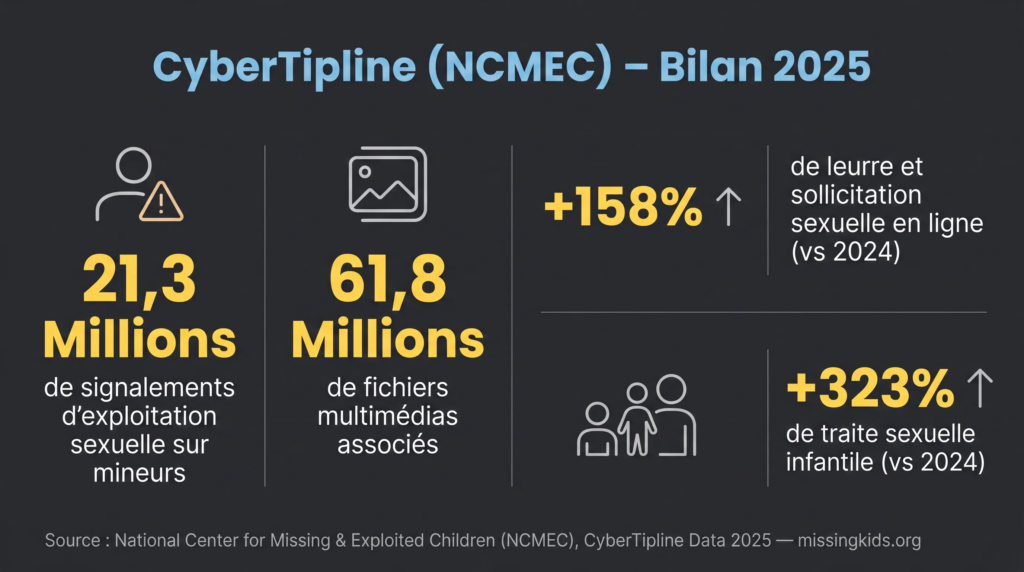
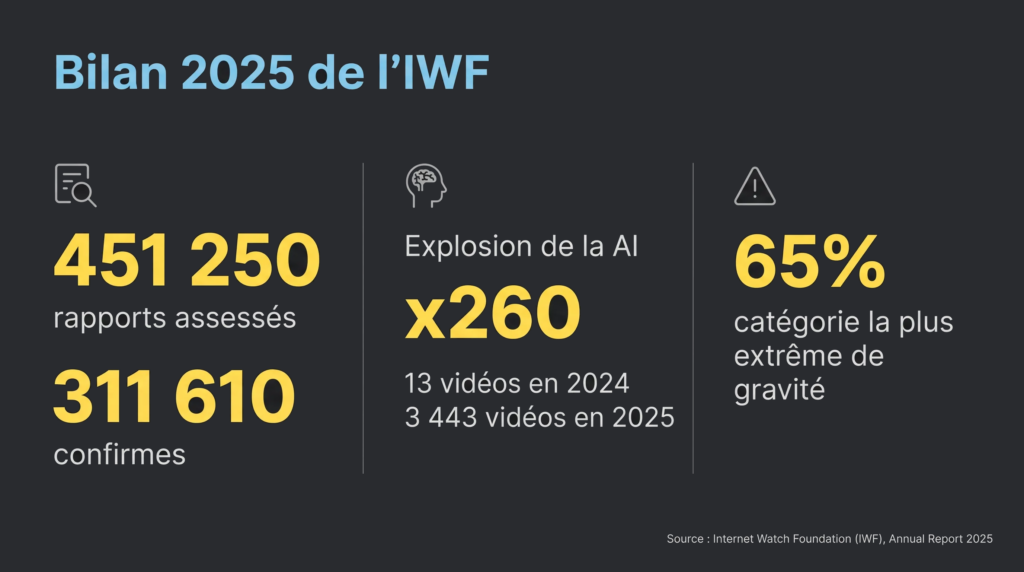
An alarming statistical magnitude
Indicators from international monitoring organizations confirm the severity and rapid spread of online child exploitation.
The Fundamental Principle of a Minor's Lack of Liability
A minor can never be held responsible for the sexual violence they experience: the blame lies solely with the perpetrator. Mechanisms of manipulation, deception, and coercion impair the victim’s ability to make sound judgments; silence, the time it takes to speak out, or the absence of physical resistance can under no circumstances be interpreted as consent.
An Urgent Need for Collective Action
The fight against child sexual abuse cannot rely solely on law enforcement; it requires a massive effort in prevention, awareness-raising, and training. This is precisely the focus of the initiatives we are carrying out on the ground, which are described in detail on our“Our Initiatives” page.